© mumok
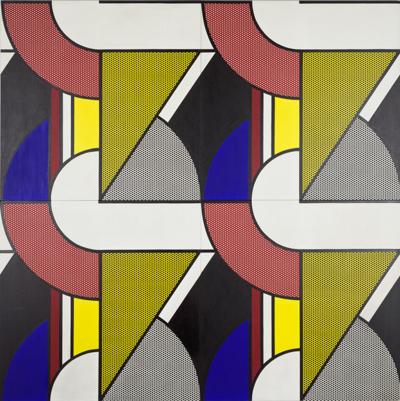
Modular Painting with Four Panels #2
Modular Painting with Four Panels #2
- Künstler*in
- Entstehungsjahr
- MaßeRahmen Höhe: 249 cm ; Rahmen Breite: 249 cm ; Rahmen Tiefe: 5.5 cm ; Objekt Höhe: 244 cm ; Objekt Breite: 244 cm
- Material
- Technik
- ObjektbeschreibungÖl, Magna auf Leinwand
- Sachgruppe
- Objektbezeichnung
- PublikationBrugger, Ingried : Roy LichtensteinNeuburger, Susanne: Hyper RealMercurio, Gianni: Roy Lichtenstein : Kunst als Motiv ; [Museum Ludwig, Köln, 2.7. - 3.10.2010]
- InventarnummerÖL-Stg 103/0
- Erwerbungsjahr1981
- Creditlinemumok - Museum moderner Kunst Stiftung Ludwig Wien, Leihgabe der Österreichischen Ludwig-Stiftung
- RechteverweisBildrecht, Wien
Links
- Social MediaShare
- Nachweis
- Archiv
- IIIF
Beschreibung
So selbstverständlich wie Roy Lichtenstein Comicstrips und Werbungen für seine Bilder heranzieht, eignet er sich auch die populärsten Bilder und Stile der Kunstgeschichte an. Diese sind für ihn frei verfügbarer Bestandteil einer banalen Massenkultur, die keinen Unterschied mehr zwischen Hoch- und Populärkultur macht. In "Modular Painting with Four Panels" bezieht sich Lichtenstein auf die Verherrlichung der Rationalität in Architektur und Design der 1930er-Jahre, die er einmal als „irgendwie blind geometrisch“ bezeichnet hat: „Die Vorliebe der 30er-Jahre für Logik hatte etwas Absurdes an sich. In meiner Arbeit setze ich gerne die 30er-Jahre zur rationalen Kunst von heute in Beziehung. Das, was heute gemacht wird, hat aber eine gewisse Ironie. Man weiß, dass es nicht mehr üblich ist, rational zu sein.“ Art déco, der Massenstil der 30er-Jahre, erlebt in den USA Ende der 1960er-Jahre ein Revival und prägt Lichtensteins nächste Umgebung in New York. "Modular Painting" veranschaulicht, wie Lichtenstein die Stilelemente des Art déco in sein, aus der Drucktechnik abgeleitetes, Rastersystem aus Punkten überträgt. Sein Interesse gilt dem Aufspüren von formalen Ähnlichkeiten, aber auch von Differenzen. Übereinstimmungen liegen in der grafischen Vereinfachung und der Standardisierung der Formen. Ein großes Quadrat setzt sich aus vier Modulen kleinerer quadratischer Bilder zusammen, auf denen jeweils dasselbe Wechselspiel von Kurven, Bögen und Diagonalen wiederholt wird.